

课程时长 12小时24分钟
学习期限 12个月 退款期限 不支持
市场价格 ¥5000.00 会员价格 免费
难度级别 中级 学习人次 3 综合评分 5.0
- 详情
- 目录

课程简介
Course Introduction
依托于复杂系统理论、图论和社会网络分析的空间句法理论,被誉为建筑和空间研究领域在二十世纪最重要理论创造之一。理论最主要创始人之一的比尔·希利尔教授曾说,“从文化和社会的意义上来说,空间绝不仅仅是人类行为和社会生活的‘背景’,它是社会和文化要素得以构成现实世界的一种关键途径。人类行为不仅仅在空间中发生,它们自身便具有了空间的形式。”这与英国首相丘吉尔1943年在下议院的名言—“我们塑造了我们的建筑,而与此同时建筑也塑造着我们”,表达了相似的含义。空间句法理论尝试通过空间和社会网络分析的方法,理解并揭示建筑和城市空间在人类社会生活中所扮演的中枢性角色,即所谓“空间的社会逻辑”。
Space syntax theory, which relies on complex systems theory, graph theory and social network analysis, is regarded as one of the most important theoretical creations in the field of architecture and space research in the 20th century. Professor Bill Hillier, one of the leading founders of the theory, once said, "In a cultural and social sense, space is more than just the 'background' of human behavior and social life. It is a key way in which social and cultural elements constitute the real world. Human behavior doesn't just take place in space, it takes on spatial form." This is similar to British Prime Minister Winston Churchill's words in the House of Commons in 1943: "We shape our buildings and they shape us". Space syntax theory tries to understand and reveal the central role of architecture and urban space in human social life through space and social network analysis, which is called "social logic of space".

随着移动互联网技术的飞速发展,人的行为、偏好和城市要素等多种类型的空间数据变得愈发开源、可及。依托于海量数据,建筑和城市规划等传统空间学科中的实证、定量研究已成为学术讨论的前沿领域和设计实践的有力支撑。以空间句法为代表的空间网络分析作为一个方法理论体系相对成熟的研究领域,近年来在区域经济、城市规划、建筑和景观设计等多个空间尺度的实践与研究中受到了广泛的应用。掌握空间网络分析的模型和方法,将有助于充分利用和挖掘空间数据资源,更好的为建筑或城市要素的测度、评估和设计所服务。

With the rapid development of mobile Internet technology, various types of spatial data, such as human behavior, preferences and urban elements, have become increasingly open source and accessible. Based on sea volume data, empirical and quantitative research in traditional spatial disciplines such as architecture and urban planning has become the frontier field of academic discussion and a strong support for design practice. As a relatively mature research field, spatial network analysis represented by space syntax has been widely applied in the practice and research of regional economy, urban planning, architecture and landscape design in recent years. To master the model and method of spatial network analysis will help to make full use of and mine the spatial data resources and better serve the measurement, evaluation and design of architectural or urban elements.
本课程将全面细致地讲解空间与社会网络分析的理论方法、模型建构和数据的可视化表达。主要内容包含区域和城市、社区和街道、公建和住宅三大部分,涵盖了空间分析中宏观、中观和微观尺度下的问题要素与方法视角。其中每一部分都包含了相互承接的理论方法讲解和案例实操两个课时:理论方法部分将结合富有代表性的具体案例,深入浅出的讲解概念、算法和模型背后的思想,以及其应用场景;案例实操部分将系统深入地学习空间网络模型的建构方法、空间分析的软件平台以及空间数据的定量可视化表达。

This course will provide a comprehensive and detailed explanation of theoretical approaches, model construction, and visual representation of data in spatial and social network analysis. The main content includes three parts: region and city, community and street, public buildings and housing, and covers the problem elements and method perspectives in the macroscopic, mesoscopic and microscopic dimensions of spatial analysis. Each part contains two periods of theoretical method explanation and case practice: The theoretical method part will combine the representative concrete cases, explain the concepts, algorithms and models in depth and in simple terms, and explain their application scenarios; The practical part of the case will systematically and deeply learn the construction method of spatial network model, the software platform of spatial analysis and the quantitative visualization expression of spatial data.

经过本课程的学习,你将较为全面地掌握空间与社会网络分析背后的理论思想以及具体的工作流程,并初步具备空间定量研究和数据可视化的技术基础。对于从事设计的同学来说,这些内容将极大地丰富方案表达的维度、方案论述的基础以及方案概念的切入点。对于从事分析研究的同学来说,这些内容将提供全新的问题视角、技术路径和工具平台,成为研究型硕士或博士学位申请的有力武器。
Through the study of this course, you will have a relatively comprehensive grasp of the theoretical ideas and specific work flow behind spatial and social network analysis, and preliminarily have the technical basis of spatial quantitative research and data visualization. For those who are engaged in design, these contents will greatly enrich the dimensions of scheme expression, the basis of scheme discussion and the entry point of scheme concept. For students engaged in analysis and research, these contents will provide a new problem perspective, technical path and tool platform, and become a powerful weapon for research master's or doctor's degree application.
讲师简介
Lecturer Introduction

Li XiaoMing
2018-至今 伦敦大学学院巴特莱特建筑学院 博士
2016-2018 东南大学建筑学院 硕士
2018年获教育部国家留学基金委公派项目全额资助,赴伦敦大学学院巴特莱特建筑学院空间句法实验室攻读博士学位,主要研究方向为空间与社会网络分析的理论和方法、公共设施空间绩效的多尺度测度与评估、空间数据的挖掘与可视化。
是全球为数不多的建筑学拿到拿到 博士全额奖学金 的人之一!
导师作品1
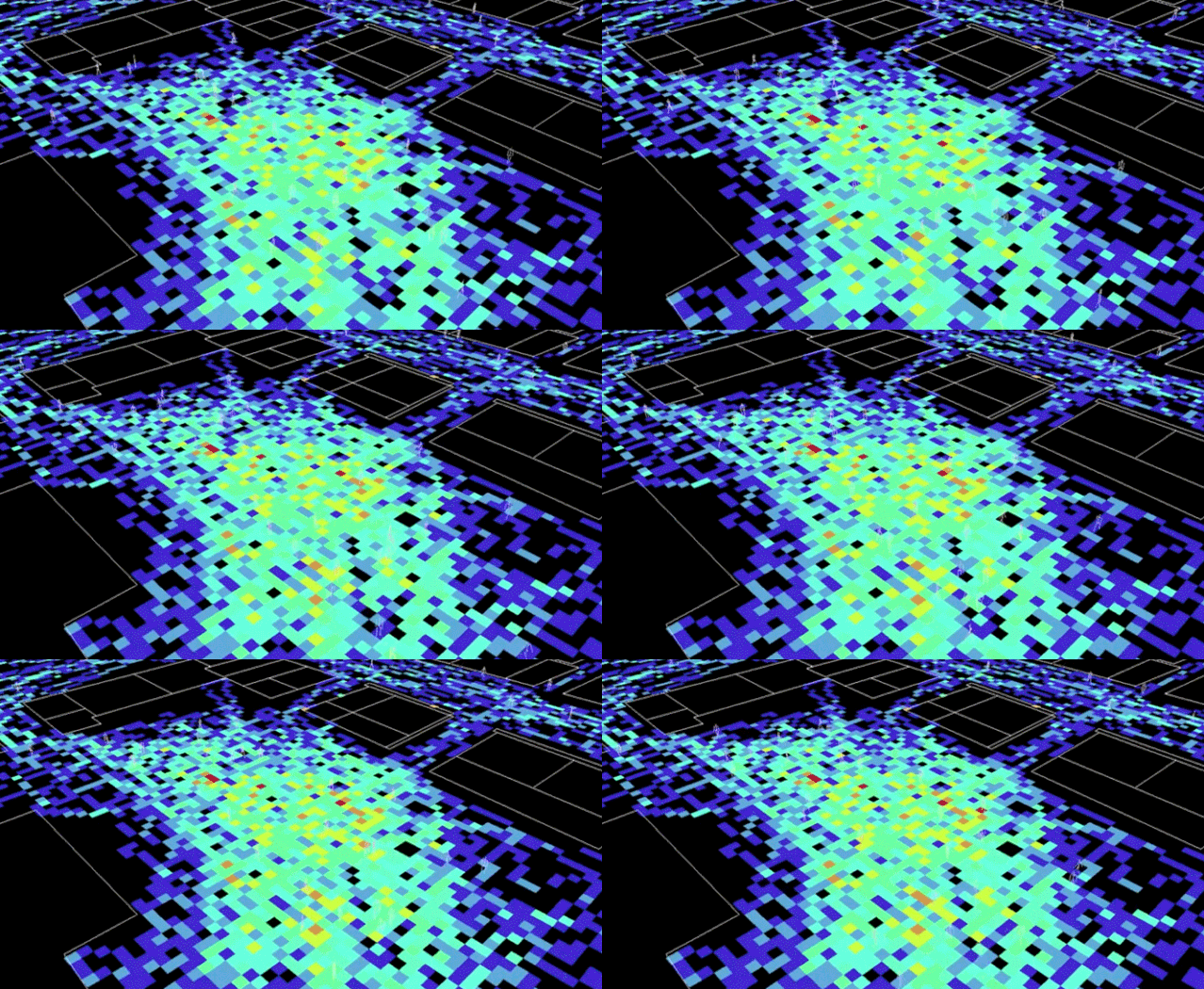
AgentBasedModelling
导师作品2
UrbanSegment

导师作品3
BlockScaleAnalysis

课程列表

课程详情
Course Details
PART 1 引言 An introductory
LESSON 1
空间是机器?理解空间背后的社会逻辑
Space is a machine? Understand the social logic behind space
A.自我介绍
Self-Introduction
B.课程结构与内容介绍
Course structure and content introduction
C.什么是空间网络分析?——空间网络分析作为一种问题角度
What is spatial network analysis? Spatial network analysis as a problem perspective

·走廊的诞生——解译“现代性”背后的人类家庭生活和住宅基因演化;

• 街道之眼——探讨现代社区生活中的“白夜”迷思;

• 天朝沙场——故宫与北京政治空间的构成纲要;

• 空间生产力——作为“交流装置”的城市以及作为资本的空间;
D.如何开展空间网络分析?——空间网络分析作为一种定量研究方法
How to carry out space network analysis? Spatial network analysis as a quantitative research method
• 数学中的“图论(Graph Theory)”、拓扑结构和复杂系统论;
• 作为计量社会学代表的“社会网络分析(Social Network Analysis, SNA)”;
·将“网络分析”引入空间研究—“空间句法(Space Syntax)”的源起、理论和方法;
E.为什么要学习空间网络分析?——空间与社会网络分析在大数据时代的应用与前景
Why study spatial network analysis? -- Application and prospect of spatial and social network analysis in the era of big data
• 多样、可用的网络开源数据;
• 图论、复杂科学和网络分析等基础理论和方法的蓬勃发展;
• 多样化的定量分析工具和平台;
PART 2 区域与城市尺度 Regional and urban scales
LESSON 2
宏观尺度空间网络分析的理论、概念与模型
Theory, concept and model of macroscopic spatial network analysis
A.基于复杂科学和系统论的城市空间网络研究
Research on urban space Network based on complex science and system theory

·“城市并非树形”:克里斯托弗·亚历山大与城市复杂系统理论;

·“自然出行”理论:空间法则如何驱动城市功能的布局;

• “中心性”理论:城市空间生长的内在机制;

• “第三类”可达性:城市的道路网络与深层机会结构;
B.城市空间要素的拓扑和网络呈现
Topology and network presentation of urban spatial elements
• 城市空间要素的拓扑和网络呈现:
• 轴线图模型;
• 线段图模型;
• 基于“深度”、“密度”和“中心性”的网络结构指标;
• 尺度、知觉与空间抗阻:直线距离、米制距离、拓扑距离、角度距离;
LESSON 3
方法、案例与操作
Methods, cases, and actions

操作案例:伦敦主城区道路网络
软件平台
DepthmapX, GIS
内容
• 轴线图模型的建构;
• 线段图模型的建构;
• 空间网络结构指标体系的计算;
• “边缘效应”与网络缓冲区的选择;
• 空间网络结构指标的标准化;
• 空间网络数据的可视化:DepthmapX与GIS平台的协同;
PART 3 街道与社区尺度 Street and community scale
LESSON 4
.中观尺度空间网络分析的理论、概念与模型
The theory, concept and model of mesoscale spatial network analysis
A.空间网络研究的理论与方法对传统城市社区和街道研究的贡献:
Contribution of theories and methods of spatial network Research to the study of traditional urban communities and streets:
• 空间网络与街道活力:现代城市社区中的“白夜”迷思;
• 空间网络与社区安全:可防卫空间与“街道之眼”的动静之辨;
• 空间网络与社会隔离:孤独、贫困、冲突与融合中的空间密码;
B.城市社区与街道空间要素的拓扑和网络呈现:
Topology and network presentation of urban community and street space elements:
• 轴线图模型;
• 线段图模型;
• 空间与功能要素整合模型;
• 基于整合网络模型的邻里性测度指标体系;
LESSON 5
方法、案例与操作
Methods, cases, and actions

操作案例:伦敦“国王十字(King's Cross)”地区的空间模型
包含道路网络、交通站点和用地功能分布
软件平台
Space Syntax Toolkit,QGIS,ArcGIS
内容
• 线段图模型的建构;
• 网络缓冲区分析;
• 网络特征要素和缓冲区的可视化;
• 路段功能密度;
• 城市开放空间的视阈和视线图分析;
PART 4 公建与住宅尺度 Public buildings and residential scale
LESSON 6
微观尺度空间网络分析的理论、概念与模型
The theory, concept and model of mesoscale spatial network analysis
A.建筑空间关系对社会关系的形塑:
The shaping of architectural space relation to social relation:
• 埃米尔·涂尔干的“关系联结”和“空间联结”
• 列维·施特劳斯的“机械模式”和“统计模式”
• 比尔·希利尔的“强程序”和“弱程序”;
• 朱利安尼·汉森对家与住宅基因型的解码;
B.建筑空间关系的拓扑和网络呈现
Topology and network representation of architectural spatial relations
• 网络关系的拓扑图;
• “深度”的概念;
C.建筑空间网络系统的建构方法:
Construction method of architectural space network system:
• 凸空间模型;
• 视线图模型;
• 轴线图模型;
•线段图模型;
LESSON 7
方法、案例与操作
Methods, cases, and actions

操作案例:英国国家美术馆
软件平台
DepthmapX, GIS
凸空间建模与分析(convex analysis)
• Connectivity
• Integration
•Choice
视阈图的建模与分析(Isovist Analysis)
• Isovist Area
• Isovist Path
视线图的建模与分析(Visual Graph Analysis, VGA)
• Visual Connectivity
• Visual Step Depth
• Visual Integration
• Visual Clustering Coefficient
PART 5 结尾 At the end
LESSON 8
理性艺术––呼唤分析性的空间理论和方法
Rational art calls for analytic space theory and method

A.回溯与总结:
Retrospective and summary:
• 空间网络分析背后的复杂性与系统性思维;
• 空间网络分析中的关键概念和模型;
B.认识论和方法论:
Epistemology and methodology:
• 结构主义、语言与建筑;
• 从机器范式到基因范式:“空间-人/环境-人”关系的认识论转变;
• 空间结构的客观实在性及其与社会的映射关系;
C.新的机遇:
New Opportunities:
• 大数据和计算机语言为空间网络分析提供了更加广阔的应用前景


更多资讯获取方式
添加“Hygge质控主管”第一时间获取灰格最新信息

微 信 号: hygge006

